Dodgers Keep Searching for Answers as Giants Add to Growing Frustration
- wtrillo
- May 12
- 4 min read
There is no elegant way to dress this up anymore.
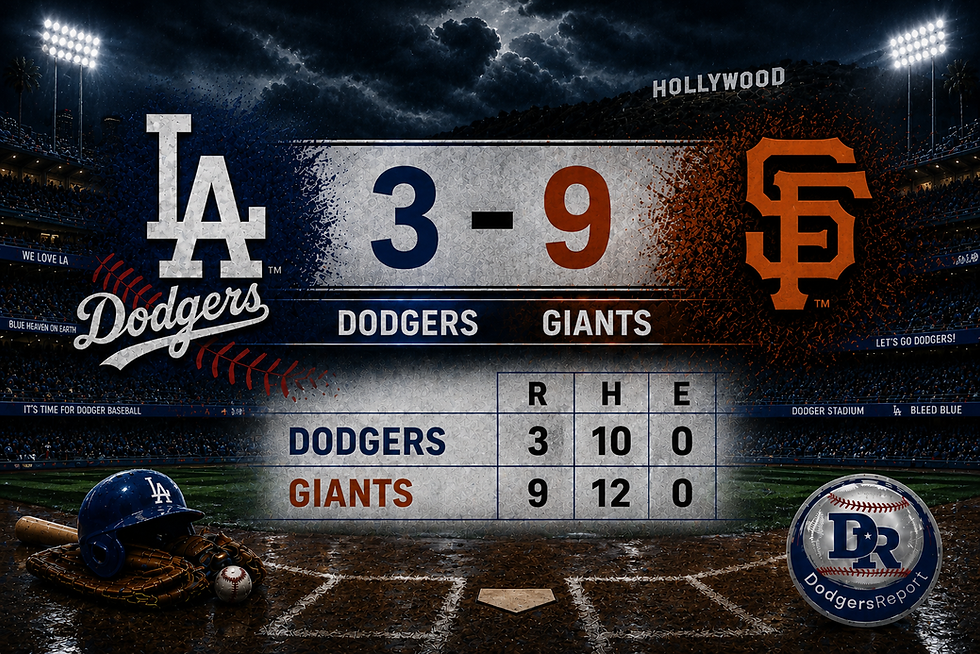
The defending two-time World Series champions have now been soundly beaten three times in four games by the lowest-scoring team in Major League Baseball. On Monday night, the San Francisco Giants arrived at Dodger Stadium carrying one of baseball’s weakest offenses and somehow left looking loose, opportunistic and entirely comfortable in a 9-3 win over a Dodgers team that currently resembles anything but a contender at ease.
The Dodgers are not broken. Teams this talented rarely are.
But they are undeniably disjointed.
The lineup feels disconnected from inning to inning. The bullpen suddenly looks unstable in spots that once felt automatic. Shohei Ohtani is pressing. Roki Sasaki continues oscillating between electric and unfinished. And with Monday’s loss, the Dodgers officially slipped into second place in the National League West behind San Diego.
None of it feels catastrophic in mid-May.
None of it feels particularly normal, either.
For stretches Monday, the Dodgers actually looked capable of snapping out of this increasingly uncomfortable funk. They collected double-digit hits, loaded the bases with nobody out in the fifth inning and repeatedly put traffic on the bases against Giants pitching.
And yet the game somehow still felt tilted toward San Francisco almost the entire night.
That has become part of the problem lately. The Dodgers are creating opportunities without ever fully controlling games.
Manager Dave Roberts, still determined to sound optimistic while the walls around him grow progressively noisier, pointed toward the positives afterward.
“Tonight was one of those nights where if you look at tonight separately, we put double-digit hits up there,” Roberts said. “We had a chance for a big inning with the bases loaded and nobody out. We ended up putting two runs on the board where you'd like to come out with a couple more.”
That sequence in the fifth inning may have summarized the Dodgers’ current existence better than anything else.
The Dodgers loaded the bases with nobody out and managed only two runs, leaving behind the feeling that an opportunity had quietly expired before the inning even ended. The line keeps stalling midway through the rally. The baton never quite gets passed cleanly to the next hitter.
Meanwhile, the Giants kept capitalizing when openings appeared.
Rafael Devers homered off Sasaki in the second inning, then later delivered the at-bat that effectively broke the game open in the seventh. After consecutive singles from Jung Hoo Lee, Luis Arraez and Casey Schmitt loaded the bases against Alex Vesia, Devers worked a two-strike walk that chased the Dodgers reliever from the game.
One batter later, Willy Adames lined a two-strike single against Will Klein to push the Giants ahead for good.
Just like that, another competitive game became another uncomfortable scoreboard.
Vesia’s recent struggles have become another developing concern for Los Angeles. The left-hander, who spent much of the last two seasons looking almost automatic in leverage spots, suddenly appears less certain of himself on the mound. Monday night he allowed three runs on three hits while recording only one out.
The inning only deepened the growing sense that nothing about this team currently feels synchronized.
Not even Ohtani.
The four-time MVP went 0-for-5 with two strikeouts and continues fighting through one of the strangest offensive stretches of his Dodgers tenure. Roberts acknowledged afterward what has become increasingly visible from the dugout and the stands alike.
“I think right now, and tonight was a classic example, I think he's just trying to swing out of it,” Roberts said. “A lot of hitters, when they are scuffling, they want to kind of swing out of it.”
That description fit Monday perfectly. Ohtani looked less like a hitter waiting for his pitch and more like someone attempting to erase two weeks of frustration with one swing.
The Dodgers are hardly alone in baseball history there. Slumping superstars have been trying to solve problems with violence since Babe Ruth was pointing at outfield fences.
Still, it remains jarring to watch an offense built around patience, depth and relentless pressure suddenly operate inning-to-inning like five strangers sharing a rideshare.
Even Sasaki’s outing somehow fit the theme.
For one inning, the rookie right-hander looked dominant, flashing the explosive arsenal that convinced the Dodgers he could become one of baseball’s defining arms. In the next inning, he looked vulnerable and unfinished. By the sixth, after Heliot Ramos doubled home two runs to put San Francisco ahead 3-2, Roberts was walking slowly to the mound again.
Sasaki finished allowing three runs over five-plus innings while throwing 91 pitches, 56 of them coming after the third inning.
In many ways, he looked exactly like what the Dodgers keep insisting he is: a work in progress.
The problem is patience becomes harder to preach when the standings start shifting and the losses begin piling up.
To Roberts’ credit, he still sounded convinced this version of the Dodgers is temporary.
“It’s frustrating while you’re in it,” Roberts said. “But we just have too much talent and too much desire to keep doing this for much longer.”
Maybe he’s right.
Talent this overwhelming usually wins out eventually. Seasons this long rarely stay tilted forever. And there are still too many accomplished players in that clubhouse for anyone to seriously believe the Dodgers have suddenly forgotten how to play baseball.
But right now, they do look like a team searching for itself inning by inning.
And for the first time in a while, the search is starting to feel longer than anyone expected.


Comments